

George Harrison and Jeff Lynne’s Best Co-Written Songs Beyond the Traveling Wilburys
By the mid-1980s, Jeff Lynne was no longer tethered to the band that made his name. With Electric Light Orchestra behind him, he drifted into a different phase of his career—one built around collaboration, curiosity, and a long-held desire to work alongside artists he admired. Songwriting and production sessions replaced tour buses, and the studio became a place where old influences and new ideas quietly overlapped.
That period placed Lynne in close creative orbit with a small circle of musicians who shared his melodic instincts and relaxed approach to craft. He found himself contributing to records by George Harrison, Tom Petty, and Roy Orbison, often blurring the line between producer and collaborator. These relationships were not driven by grand concepts or future band plans; they grew out of mutual trust, easy chemistry, and a shared love for concise, well-built songs.
Before the Traveling Wilburys gave that circle a name, Lynne and Harrison had already laid important groundwork together. Their partnership reached a high point on Harrison’s 1987 album Cloud Nine, where the two co-wrote several songs that captured Harrison’s renewed confidence and Lynne’s polished, hook-forward sensibility. Those tracks stand on their own, separate from the Wilburys mythos, revealing a collaboration that was already fully formed before it ever became part of a supergroup narrative.
“When We Was Fab” by George Harrison
“When We Was Fab” works as a playful memory piece, but it is far from a misty-eyed tribute. Harrison approaches his past with a grin rather than reverence, filtering Beatlemania through humor, wordplay, and a slightly surreal edge. The song feels self-aware, as if he’s acknowledging how strange that era looks in hindsight without pretending it was simple or sacred.
Jeff Lynne’s presence is obvious in the track’s layered vocals and tight structure, yet the song never loses Harrison’s voice. References to taxmen, authority figures, and the chaos of fame slip between jokey backing vocals and quick melodic turns. It’s reflective without slowing down, and nostalgic without turning sentimental, a balance that suits Harrison’s late-’80s mindset.
What makes the collaboration stand out is how comfortably it sidesteps reverence. Rather than framing the Beatles years as untouchable history, Harrison and Lynne treat them as lived experience—messy, funny, and occasionally absurd. The result is a song that looks backward while sounding firmly rooted in the moment it was made.
“That’s What It Takes”
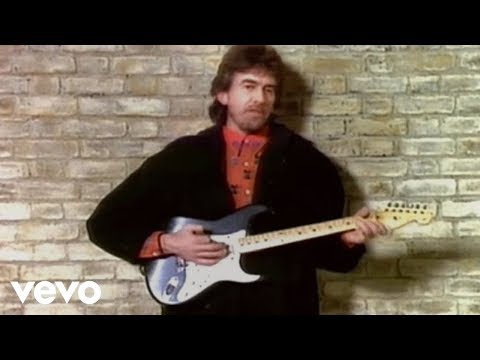
“That’s What It Takes” carries a quieter determination than some of Cloud Nine’s more overtly upbeat moments. Built around persistence rather than triumph, the song unfolds patiently, allowing its message to settle without fanfare. Harrison’s vocal delivery is restrained, almost conversational, which gives the lyrics added weight.
The song reflects the long-standing musical relationship between Harrison and Gary Wright, with Lynne acting as the connective tissue that sharpens the arrangement. Piano lines and subtle harmonic shifts give the track a grounded feel, avoiding excess while still sounding polished. It’s a collaborative effort that feels genuinely shared rather than divided by roles.
Rather than pushing toward a big emotional payoff, the song stays focused on endurance. Its repetition feels intentional, reinforcing the idea that progress often comes from steady effort rather than dramatic breakthroughs. That mindset mirrors where Harrison was creatively at the time—confident, clear-eyed, and uninterested in chasing old expectations.

“This Is Love”
“This Is Love” leans into optimism without slipping into simplicity. The lyrics speak to renewal and clarity, but they do so with a sense of earned understanding rather than naïve hope. Harrison frames love as something that strips away confusion, not something that ignores it.
Musically, the song showcases Lynne’s gift for clarity and momentum. Bright guitars, stacked harmonies, and a clean rhythmic drive give the track an open, sunlit quality. It feels designed to move forward, echoing Harrison’s broader creative resurgence during this period.
The song’s later visual companion, filmed in Hawaii, reinforced that sense of ease and openness. Waves, wide skies, and Harrison’s relaxed presence matched the song’s tone perfectly. Together, they captured a moment when his collaboration with Lynne wasn’t about revisiting the past or building a supergroup identity, but about writing songs that felt genuinely light on their feet.