

Ian Anderson Explains His Approach to Writing Jethro Tull Lyrics
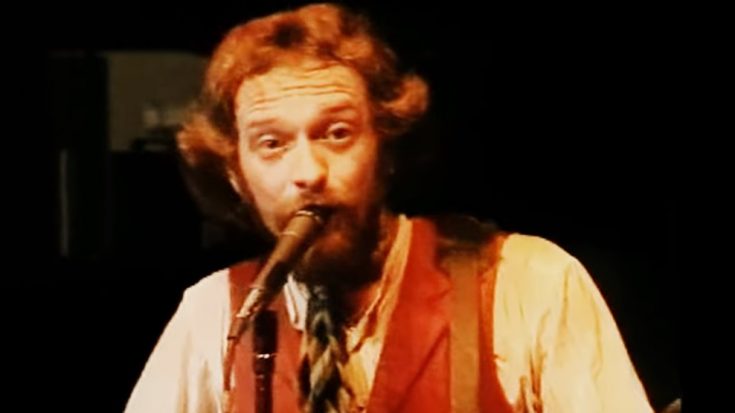
Ian Anderson in Jethro Tull's London show, 1977 - RemyTena2 / YouTube
For someone who has written hundreds of lyrics across more than five decades, Ian Anderson has never treated words as sacred artifacts. They were working documents—scribbled in hotel rooms, rushed onto album sleeves, and sometimes left at the mercy of record-company typists. That casual relationship with presentation eventually led to frustration, especially as mistakes multiplied online and misheard lyrics took on lives of their own.
That frustration is what finally pushed Anderson to complete Silent Singing, an illustrated lyric book collecting 300 pieces from across his career with Jethro Tull and beyond. It wasn’t a project driven by demand or nostalgia. Anderson openly described it as a vanity exercise, one fueled more by personal closure than by any belief that the world needed a definitive lyric archive.
Yet the book ended up doing more than correcting errors. It prompted Anderson to re-engage with the way his lyrics were born in the first place—often quickly, instinctively, and without overthinking. Looking back, he found far fewer moments of embarrassment than he expected, and that realization reshaped how he viewed his younger self as a writer.
Lyrics as the First Spark, Not the Final Layer
Anderson has long resisted the idea that lyrics merely decorate finished music. In many cases, the words arrived first, carrying with them a rhythm and intent that shaped everything that followed. One of the clearest examples is “Thick as a Brick,” which began not with a musical motif but with a single, casually written line.
“I really don’t mind if you sit this one out” appeared on a scrap of paper during a tour stop, written without ceremony in a hotel room. What mattered wasn’t polish, but potential. Anderson immediately sensed that the line could stretch, expand, and sustain a much larger narrative. That instinct eventually grew into Thick as a Brick, an album built almost entirely around a lyrical concept.
That moment reflects Anderson’s broader approach. He doesn’t wait for a complete vision. Instead, he trusts the first line to act as a trunk, with the rest of the song growing outward like branches. Once that core idea appears, structure and story can follow naturally.
Observation, Memory, and Building Stories
Some of Anderson’s lyrics are rooted in fleeting encounters rather than abstract ideas. “Budapest,” from Crest of a Knave, came together in the early morning hours after Jethro Tull’s first concert in Hungary in 1986. The Cold War context lingered in the background, but the song itself was sparked by a far more personal image.
The night before, a young woman had stocked the band’s dressing-room refrigerator. The promoter mentioned she was a middle-distance runner training for Hungary’s Olympic team. By dawn, Anderson had already written the opening line: “I think she was a middle-distance runner.” From there, the song unfolded as a quiet act of imagination layered onto a real person briefly encountered.
This method—starting with a specific detail and allowing it to grow into something broader—appears again and again in Anderson’s work. He describes it as adding “leaves on the bare branches,” turning a moment into a narrative without needing it to be autobiographical. The truth lies not in accuracy, but in emotional plausibility.
Revisiting Old Words Without Cringing
One of Anderson’s biggest concerns before assembling Silent Singing was the fear of confronting lyrics that no longer held up. He expected naivety, excess, or moments that would feel embarrassing through the lens of age and experience. That expectation turned out to be largely unfounded.
Instead, he found himself surprised by how well most of the lyrics stood their ground. Context mattered. When placed alongside the music and the era in which they were written, the words felt appropriate rather than awkward. There were only a handful—two or three, by his own count—that made him wince.
Tellingly, Anderson has no intention of naming them. That restraint fits his overall attitude toward his work. He doesn’t romanticize it, but he also doesn’t disown it. The lyrics were honest products of their time, written quickly, instinctively, and without the benefit—or burden—of future hindsight. For Anderson, that may be their greatest strength.