5 Guitar Solos That Show Ritchie Blackmore’s Genius
via "Antony Berner" / YouTube
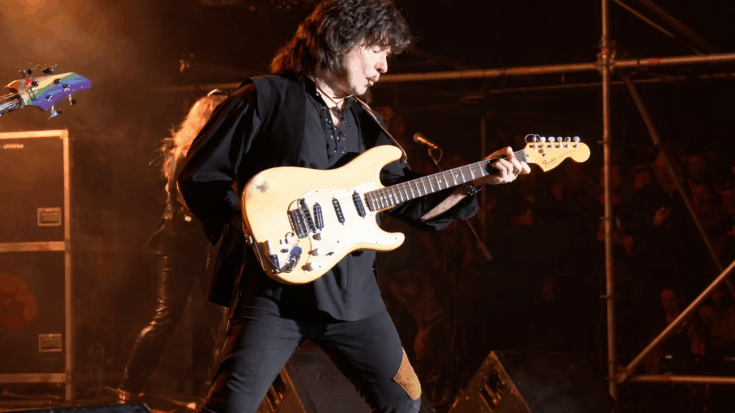
Turning 81 feels like a milestone worth pausing for, especially when it belongs to someone who reshaped how the electric guitar can speak. Ritchie Blackmore built a reputation not just on speed or precision, but on the way his playing seems to stretch beyond the instrument itself. There’s a certain mystery in his phrasing, the kind that makes listeners wonder if he’s tapping into something just out of reach for everyone else.
That sense of disbelief isn’t new. Even fellow greats have struggled to explain it, including Jeff Beck, whom Blackmore once joked must be “cheating” to find notes no one else could hear. Ironically, anyone who has tried to learn one of Blackmore’s solos might feel the same way about him. His runs can feel unpredictable, almost impossible to map out, yet they always land exactly where they should.
What sets him apart goes deeper than technique. There’s a strong emotional current running through his work, often borrowing from classical and romantic traditions without losing its raw edge. Whether the passage is intricate or stripped down, the feeling is always front and center. The following five solos capture that balance, offering a clear window into why Blackmore’s playing continues to hold its ground decades later.
“Smoke On The Water” (Machine Head, 1972)
There’s no escaping the opening riff of this song. It’s one of those rare musical ideas that crossed over into everyday culture, the kind people recognize even if they’ve never owned a Deep Purple record. Its simplicity is exactly what makes it powerful. Every note feels deliberate, and it leaves just enough space for the rest of the track to breathe.
Because of that iconic intro, the solo often gets less attention than it deserves. Ritchie Blackmore approaches it with restraint rather than excess, leaning into melody instead of speed. Each bend feels like it has a purpose, almost as if he’s continuing the story the riff began rather than trying to outshine it.
What makes the solo stand out is how natural it sounds. There’s no sense of showing off, even though the phrasing reveals a deep understanding of tone and timing. Many players might have treated the solo as an afterthought after writing such a famous riff, but Blackmore treats it as just as important, giving the song a second peak that’s just as memorable as the first.

“Shake With Me” (The Outlaws Singles, 1964)
Before the fame of Deep Purple, Blackmore was already chasing a heavier sound with The Outlaws. “Shake With Me” captures that early experimentation, sitting somewhere between the rock of its time and something tougher that hadn’t fully formed yet. There’s a roughness to it that feels ahead of its era.
The solo carries that same forward-thinking energy. You can hear Blackmore pushing past the limitations of what guitarists were expected to do in the mid-60s. His phrasing doesn’t settle into predictable patterns, and there’s a sense that he’s searching for a new voice on the instrument rather than copying what was already popular.
Listening now, it feels like a blueprint in motion. The confidence isn’t fully polished yet, but the ideas are already there. That mix of curiosity and boldness would later define his work, and this track shows the early spark of a style that would soon reshape hard rock guitar.

“Burn” (Burn, 1974)
By the time “Burn” arrived, Deep Purple had fully embraced a heavier, faster sound, and Blackmore met that shift head-on. The track moves with urgency, driven by a relentless pace that leaves little room for hesitation. From the opening moments, the guitar feels like it’s pulling everything forward.
Blackmore’s solo matches that intensity without losing control. Even as the song stretches past the six-minute mark, his playing never drifts into repetition. Instead, he keeps introducing subtle variations, building tension and release in a way that keeps the listener locked in from start to finish.
There’s also a sense of leadership in how the guitar shapes the song. With David Coverdale and Glenn Hughes contributing to the writing, the track still feels anchored by Blackmore’s direction. His solo doesn’t just decorate the song, it helps define its identity, turning it into one of the band’s most enduring recordings.

“Stargazer” (Rising, 1976)
When Rainbow came together, it gave Blackmore a wider space to explore ideas that didn’t always fit within Deep Purple. “Stargazer” quickly became the centerpiece of that vision. It’s an ambitious track that leans into fantasy themes, carried by the commanding voice of Ronnie James Dio and a sense of scale that few rock songs attempted at the time.
Part of what makes the track so striking is its orchestral backing. The addition of the Munich Philharmonic Orchestra gives the song a weight that pushes it beyond standard hard rock. Blackmore responds to that backdrop by adjusting his approach, weaving his guitar lines into the arrangement rather than sitting on top of it.
His solo feels almost cinematic. Instead of rushing through fast runs, he builds tension slowly, letting each phrase rise and fall alongside the music. There’s a clear classical influence in the structure, but it never feels forced. It sounds natural, as if this was always the direction his playing was meant to take, and it turns the song into one of his most complete performances.

“Wasted Sunsets” (Perfect Strangers, 1984)
When Deep Purple reunited in the mid-80s, expectations were mixed. Time had passed, trends had shifted, and there was a question of whether the old chemistry could still hold. “Wasted Sunsets” answered that quietly but convincingly, showing a more reflective side of the band.
Blackmore’s solo on this track strips everything back. There’s no rush to impress, no need for speed. Instead, he leans into space and tone, letting each note ring out long enough to carry its full emotional weight. It’s the kind of playing that demands patience from both the guitarist and the listener.
What lingers is the feeling rather than the technique. The phrasing sounds almost fragile at times, yet it never loses its control. Without relying on flash, Blackmore manages to deliver one of his most moving performances, proving that his strength as a guitarist isn’t just in complexity, but in knowing exactly how much to say and when to stop.