

Journey Drummer Steve Smith Delivers Stunning Drumeo Cover of ‘Would?’
via Drumeo / YouTube
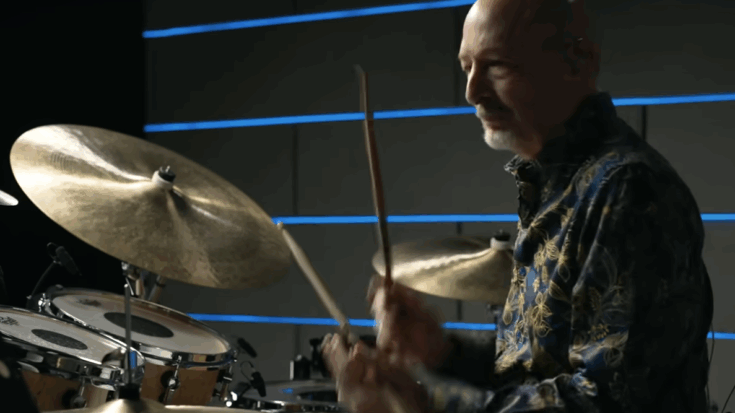
Steve Smith has spent decades shaping rock and fusion music, but his recent appearance on Drumeo’s “For the First Time” series pushed him into unexpected territory. The Journey drummer was handed Alice in Chains’ “Would?”—a defining track of the ’90s grunge era—and asked to build a drum part on the spot without ever hearing the original. It’s a concept made to reveal instincts, and Smith’s instincts didn’t disappoint.
The challenge set the tone early. Host Brandon Toews teased whether Smith was ready to “join a grunge band,” prompting a confident grin from a drummer who understood exactly what the task required: loosen up, hit harder, and lean into the raw edge of the genre. With the drumless track rolling, Smith immediately began locking in to the pulse created by Jerry Cantrell’s guitar and Mike Starr’s heavy bass lines. Even as the song’s shifts caught him off-guard, he treated the surprises as creative sparks rather than hurdles.
By the time the first listen ended, Smith was already shaping his plan. He talked through the arrangement with Toews, noting the changing dynamics and the guitar-driven rhythm patterns that could either guide or mislead him. It was clear that he intended not to replicate any expected approach but to respect the song by playing it through his own musical lens.

A First Listen Full of Curves
Smith’s early reactions made it obvious why Drumeo keeps bringing seasoned musicians into this series. As he absorbed the transitions between verse, chorus, and the atmospheric bridge, he paid close attention to how the song breathed—where it tightened and where it stretched. Those details would become his roadmap once the sticks were in motion.
He admitted that the song’s melodic shifts caught him off guard, especially the haunting outro that carries one of Alice in Chains’ most memorable lines. Instead of treating the structure as unfamiliar terrain, he dissected it with the calm curiosity of someone who has spent a lifetime behind the kit. Even without knowing the original, he recognized how much the bass was doing and how the guitars pushed the momentum forward.
When Toews asked if he had ever heard “Would?” before, Smith laughed and shook his head. Drumeo’s format had worked its magic once again—drop a master into a new musical world and watch creativity take over. That discovery phase set the stage for everything that followed.
Jazz Touches, Heavy Hits, and Mitch Mitchell Spirit
Smith’s first playthrough leaned on familiarity: tom-heavy patterns, relaxed phrasing, and touches of jazz sensibility that have long defined his playing. He used the chart as a guide but kept plenty of room for instinct. The result was fluid and exploratory, even if it sat lighter than what Alice in Chains fans might expect.
His second attempt tightened things up with more punch and aggression. The hits were heavier, the transitions clearer, and the confidence unmistakable. It was a clear step forward, as if he had already internalized the song’s push-and-pull and was now ready to lean into it. Even Toews noticed how quickly Smith adapted between takes.
When Smith mentioned Mitch Mitchell as an influence for his approach, everything clicked into place. The rolling toms, the loose swing within the groove, and the interplay with the guitar all echoed Mitchell’s trademark style. It wasn’t a direct imitation—more like a nod from one veteran to another while crossing genres that rarely intersect.
Bridging Classic Rock Feel With Grunge Intensity
Smith’s last performance blended the best ideas from his earlier runs. He kept the tom-driven character from the first take but added the weight and definition he found in the second. The tempo shifts, which could easily trip a less experienced drummer, were handled with near-perfect awareness. It still had Smith’s signature looseness, but that looseness made it interesting—an unexpected fusion of classic rock phrasing over a grunge backbone.
After wrapping his final pass, Smith finally heard Sean Kinney’s original drum part. His reaction was honest admiration. He picked up on the syncopation, the power of the toms, and the way Kinney built tension against the guitar lines. Even without hearing the original before recording his take, Smith instinctively gravitated toward similar anchor points.
Toews closed the session with a grin, telling Smith he was ready to join a grunge band. It was a lighthearted conclusion, but the idea didn’t seem as far-fetched after hearing what Smith crafted in just a short window. The entire session became a reminder of what intuition, experience, and open-minded musicianship can bring out—even when the genre is miles away from one’s home turf.