

Here’s the First Look at Ace Frehley’s Final Resting Place
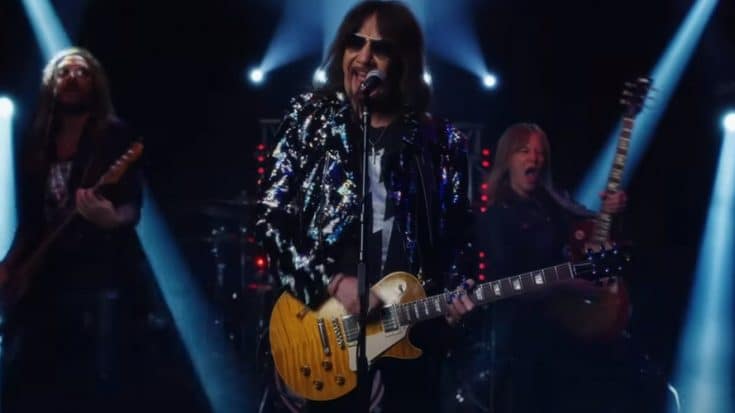
via Ace Frehley / YouTube
The first public photo of Ace Frehley’s final resting place has stirred a mix of sadness and gratitude among fans who followed him from KISS’s early club days to his storied solo career. The polished stone crypt at Woodlawn Cemetery in the Bronx now bears his real name, Paul “Ace” Frehley, along with his birth and death years. It’s a simple but striking marker for a musician whose influence stretched far beyond the makeup and the lightning bolt guitar.
Woodlawn Cemetery, a place Ace always felt connected to because of its proximity to where he grew up, became the site of his burial in late October. The guitarist was laid to rest following a private memorial attended by family, friends, and former bandmates. That closeness to his childhood roots was honored by those who knew him best, who made sure his wishes were respected to the letter.
The moment the photo surfaced, fans recognized it not as a spectacle but as a quiet, final chapter in the life of a musician whose career spanned more than five decades. His legacy—one of raw talent, memorable riffs, and a rollercoaster of personal battles—now rests in a place tied to his earliest memories. It marks the end of an era, but also the beginning of how future generations will remember him.
A Private Farewell Among Friends and Bandmates
The memorials held on October 21 and 22 were deeply intimate, far from the spectacle many might have expected for a musician of Ace Frehley’s fame. The first gathering in Yonkers brought together around 75 people, most of them musicians who had shared stages, studios, or long-night road stories with him. It was a room filled with people who saw Ace the person, not just the Spaceman.
Notably, all three of his original KISS bandmates—Paul Stanley, Gene Simmons, and Peter Criss—attended both the service and the burial. Their presence offered a bittersweet reminder of KISS’s complicated but undeniably historic beginnings in 1973. Whatever disagreements had simmered over the decades, the group stood together one last time to honor one of their own.
Eddie Trunk, a longtime friend and champion of Ace’s solo work, shared that the burial took place near where Ace’s parents are buried. That detail carried weight for fans who knew how much family meant to him and how often he referenced his Bronx upbringing. It was a goodbye grounded in familiarity, not fanfare—just as Ace had asked.
The Tragic Circumstances Behind His Passing
Ace Frehley’s death on October 16 came after a series of falls that ultimately caused a fatal brain bleed. According to the medical examiner’s report obtained by TMZ, the injuries included contusions, fractures, and a subdural hematoma. He had also suffered a stroke and was placed on life support before his family made the difficult decision to let him go.
These details were painful for fans, especially because Ace had been preparing for new chapters in his music career. He had recently canceled tour dates due to medical issues, but few expected they were connected to something this severe. Even in the days leading up to his final hospitalization, he had been working on Origins Vol. 3, the next installment of his cover-song series.
His family later shared that they were able to surround him with love and calm in his final moments. Their statement reflected both grief and admiration for how much he accomplished, how much he survived, and how deeply he impacted those around him. It was a reminder that behind the leather, the makeup, and the mythology was a father, a brother, and a man who fought hard to rebuild his life in sobriety.
A Legacy Cemented in KISS History and Beyond
Ace’s place in rock history is already secured. As one of the founding members of KISS, he shaped the band’s identity with his melodic, space-themed lead guitar style and his unpredictable stage presence. He appeared on the band’s first nine albums and returned for Psycho Circus in 1998, sealing his reputation as the quintessential Spaceman even through years of lineup changes.
His journey wasn’t always smooth, marked by substance abuse struggles and famously tense relationships with Simmons and Stanley. But Ace’s story also included redemption—most notably his decision to get sober in 2006, a change inspired by his daughter Monique. In later interviews, he spoke candidly about the moment he realized he needed help, giving fans one more reason to admire his honesty.
Beyond KISS, Ace built a solo career that connected deeply with players and fans of guitar-driven rock. From 10,000 Volts to the Origins series, he never stopped creating. His final resting place at Woodlawn now stands not only as a memorial but as a symbol of a life marked by turbulence, reinvention, and undeniable musical impact. It’s a quiet tribute to a loud legacy.